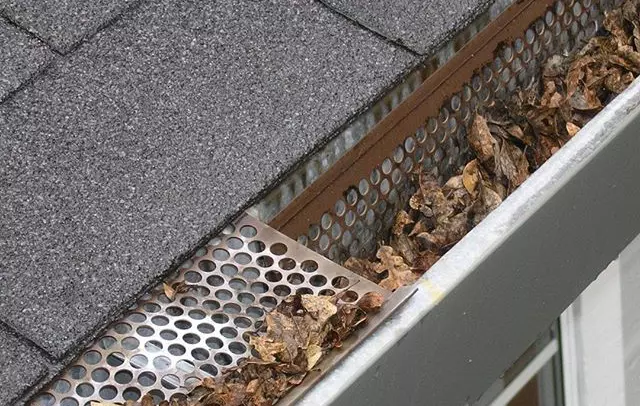
“I have gutter guards. Why is water pouring over the front of my house?”
We take that call every fall, almost always the morning after the first heavy, cold rain — a homeowner in the driveway watching water sheet off the front edge of a system sold to them as maintenance-free. Usually nothing is broken. The guards are doing what guards do. The gutter underneath them is simply full.
Here is the honest version from crews who open guarded gutters across Chicagoland every October and November: guards are clog reduction, not elimination. They buy you years between cleanings instead of months, not forever. Below is what actually gets past a guard here, the free checks worth running before you pay anyone, and what gutter guard cleaning really costs when you do need it.
Why “Maintenance-Free” Was Always a Stretch
No guard blocks every bit of debris, and that is not a knock on guards — it is physics. A guard has to let water through, so it has to have openings, so anything smaller goes through too. Micro-mesh has the smallest openings and the best track record, and it still passes shingle grit and pollen.
What a guard really changes is where the debris ends up. On an open gutter you see the problem: leaves over the lip, a downspout packed with sludge. On a guarded gutter, whatever gets through settles into a channel you cannot see, and whatever does not mats on top of a surface you also cannot see. That invisibility is the real issue — homeowners with open gutters know when they are due, while homeowners with guards believe they are covered right up until a storm proves otherwise.
What Actually Gets Through a Chicagoland Gutter Guard
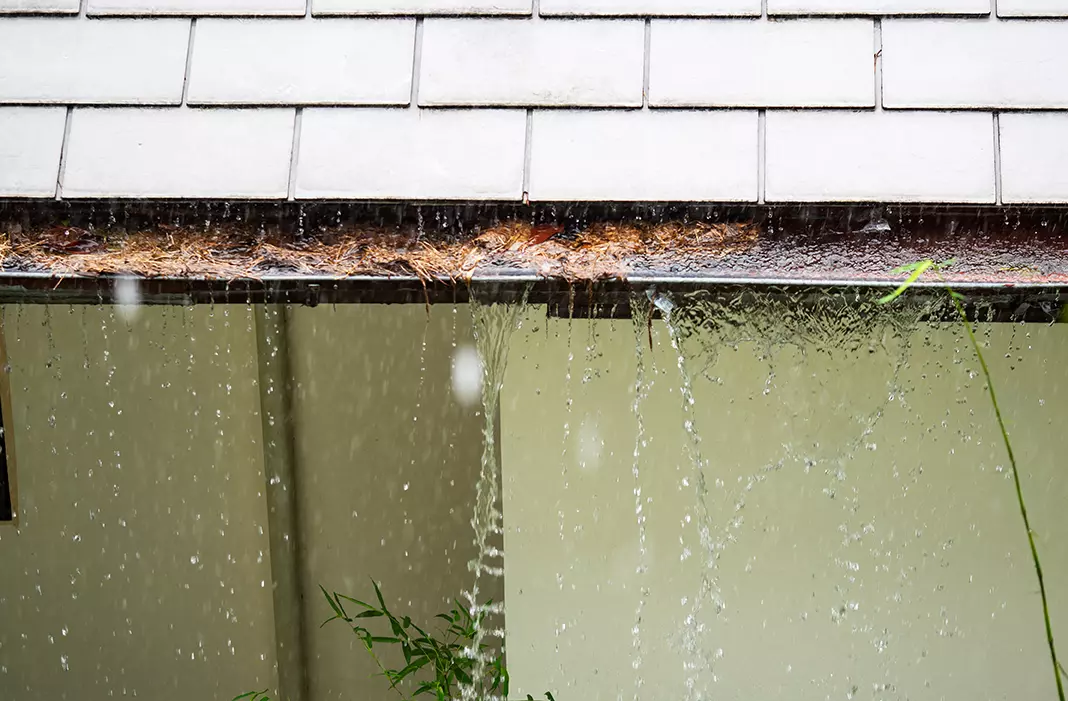
Our technicians pull the same short list off guarded systems year after year, and almost none of it is what people picture when they think “clogged gutter.”
- Asphalt shingle granules. The one that surprises people most. Your roof sheds gritty mineral granules every year, heaviest once it is past the halfway point of its life. That grit washes straight through most guards and settles into a dense, sandy layer water cannot move — more like wet cement than leaf litter, and the single most common thing our crews scoop out of a guarded gutter.
- Maple samaras. The helicopters. They are narrow enough to slip through screen guards edge-on, then swell and mat once they are wet.
- Oak catkins and late oak leaf drop. Chicagoland oaks are why a September cleaning so often needs redoing. Oak and beech species delay leaf drop through a trait called marcescence — University of Illinois Extension explains these trees form their leaf-shedding layer late or only partially, so dead leaves hang on through much of the winter. In wooded suburbs that means a second debris wave long after the maples finish.
- Cottonwood fluff and pine needles. Both wedge into mesh openings rather than passing through, forming a felt-like mat that sheds water sideways.
- Roof moss, seed pods, and wind-blown dirt. Individually minor, collectively the binder that turns the rest into a crust.
If your gutters are open rather than guarded, the same list applies — just faster and more visible, and standard gutter cleaning or gutter debris removal handles it.
Why the Buildup Only Shows Up in Fall
Two things stack up at once. Debris volume peaks as the trees drop, and rainfall turns colder and heavier. A gutter coping fine in July with a half-inch of granule sludge in the bottom cannot keep up when three weeks of leaf litter land on top.
Then the temperature drops and a slow gutter becomes an expensive one. Standing water in a blocked channel freezes, and frozen gutters help ice build at the roof edge. That is the pathway from an ignored clog to an ice dam removal call in January — and ice dam work costs several times what a fall cleaning does.
Fall also exposes how uneven our service area is. A bare corner lot might genuinely go three years between guard cleanings. A home under mature oaks needs attention every fall, which is why Northbrook gutter cleaning books out earlier than almost anywhere else we work. Tree cover, not the calendar, sets your schedule. If you are not sure when yours finish dropping, we mapped it out species by species in when to clean gutters in fall.
Free Checks to Run Before You Call Anyone
Please do these first. Most take ten minutes, all are free, and plenty of homeowners who run them find out they do not need us at all.
- Watch during the next real rain. The most useful diagnostic there is, and it costs nothing but a raincoat. Walk the perimeter while it is pouring and note where water spills. Overflow at one corner usually means a blocked downspout; along a whole run, a packed channel or guard surface; only in torrential rain, often nothing wrong at all.
- Tap the downspouts. Knuckle-rap each one as far up as you can comfortably reach. A hollow ring means clear; a dull thud means packed debris, usually right at the elbow.
- Check the splash zone. Dry soil under a downspout after a storm, while the gutter above it is soaked, means water is not getting through.
- Zoom in from the ground. Photograph the gutter line at full phone zoom, or use binoculars. Plant growth, sag, matted needles, or granule staining down the fascia all show up clearly from thirty feet away.
- Clear what is genuinely reachable. If a single-story section is safely accessible from stable ground, brushing loose litter off with an extension pole may be all it needs.
Timing matters more than people realize. You want debris off before water in the channel starts freezing, and that window closes sooner than expected — the National Weather Service puts the normal first fall freeze at O'Hare on October 19, based on 1991–2020 normals, with Rockford six days earlier. Late October is not early; it is roughly the deadline.
When Your Guards Don't Need Cleaning at All
We would rather tell you to skip it than sell you a visit you do not need. Save your money if all of these are true:
- Your guards were installed or professionally serviced within the last twelve months.
- No mature trees overhang or sit within about thirty feet of the roofline.
- Water flows cleanly from every downspout in heavy rain, with no overflow anywhere.
- Your roof is relatively new, so granule shed is still minimal.
A home matching that description can reasonably go two to three years between services. Plenty of the properties we cover in open subdivisions fall into that category, and we tell those homeowners so on the phone.
The flip side: under heavy canopy, annual service is not an upsell. Homes we handle for Lake Forest gutter cleaning sit under some of the oldest tree cover in the region, and those guards fill every year without fail.
What We Find Under Each Guard Type
We open all four common systems every week, and each one hands our crews a different problem.
- Micro-mesh. The system we most often find clean underneath. Our work is on top: clearing the pollen-and-dust film that blinds the mesh so water runs off the front instead of through it.
- Screen and perforated metal. These are the ones we lift to find a packed channel while the top looked fine — needles, samaras, and seed pods that slipped through. We budget extra time for them.
- Reverse-curve covers. We rarely take these off. We clean the curved nose where debris collects, because once that lip is fouled water overshoots the gutter entirely.
- Foam inserts. The system we like least. We pull the foam, wash it, and let it dry before it goes back, because debris sits inside it holding moisture.
Whatever we find, we work the same way: lift or clean the guard, clear the channel, flush the downspouts, and put every panel back exactly as it was. If you do not know what is on your roof, send us a photo when you request a free quote and we will tell you.
What Gutter Guard Cleaning Costs in Chicagoland
Guard cleaning is our standard gutter cleaning price plus a guard-handling add-on, because lifting, cleaning, and reseating guards takes real extra time. Base rates by square footage and stories:
| House square footage | 1 story | 2 story | 3 story |
|---|---|---|---|
| Under 2,000 sq ft | $100 | $150 | $200 |
| 2,001–3,000 sq ft | $125 | $150 | $200 |
| 3,001–4,000 sq ft | $150 | $200 | $250 |
| 4,001–5,000 sq ft | $175 | $225 | $300 |
| 5,001–6,000 sq ft | $200 | $250 | $350 |
| 6,001 sq ft or larger | Call for price | ||
Specifics that come up constantly: raised ranches count as 1.5 stories, starting at $125. Split-levels fall under two-story pricing. Detached garage gutters or roofs run $25 to $75 by size. The guard add-on depends on your square footage and guard type — we do not publish a flat number, because a small screen system and a full micro-mesh wrap are genuinely different jobs. We confirm the exact amount before work begins, and the estimate is free.
What you are paying for, beyond labor, is not doing this off a ladder. Ladder work at roof height is the most dangerous part of home maintenance by a wide margin: CDC's National Institute for Occupational Safety and Health recorded 113 fatal work-related ladder falls and roughly 34,000 nonfatal ladder-fall injuries treated in U.S. emergency departments in 2011 — and those are people who climb ladders for a living. We have cleaned Chicagoland gutters since 2012 out of three offices in Buffalo Grove, Libertyville, and Lombard. Every technician is trained, background-checked, insured, and licensed, and arrives in a marked vehicle and uniform. Every job carries our 100% satisfaction guarantee: if something is not right, call within seven days and we will re-clean the area or refund that portion, your choice. Check our service areas to confirm we cover your town.
The second thing you are paying for is not wrecking the guards. Prying panels off with a screwdriver bends clips, warps mesh, and cracks brittle covers — and a deformed guard never seats right again.
Your Fall Gutter Guard Checklist
- Walk the perimeter in the next heavy rain and mark every overflow point.
- Tap-test each downspout for a dull thud.
- Check for dry soil under downspouts after a storm.
- Photograph the gutter line at full phone zoom; look for growth, sag, matting, granule staining.
- Note your guard type — micro-mesh, screen, reverse-curve, or foam.
- Count mature trees within thirty feet of the roofline; note any oaks.
- Check your roof's age; older asphalt shingles shed far more granules.
- Brush loose debris off any guard section reachable from stable ground.
- Book before the mid-October freeze window; remember oaks drop after everything else.
- Still unsure it is a real problem? Read the gutter cleaning myths that cost homeowners most.
Frequently Asked Questions
Do gutter guards really need to be cleaned?
Yes. No gutter guard is truly maintenance-free. Guards keep out large leaves and twigs, but shingle grit, pollen, pine needles, and seed pods still work through or pile on top. Guarded gutters need cleaning less often than open ones — not never.
How often should gutter guards be cleaned in the Chicago area?
Most guarded gutters here should be checked once a year, ideally in late fall after the leaves drop. Homes under pines, maples, or heavy tree cover need it more often; a newer system on an open lot with a newer roof can stretch to two or three years.
Will you damage my gutter guards when cleaning them?
No. Our technicians work with micro-mesh, screen, reverse-curve, and foam systems routinely. We lift or unclip removable guards, clean the gutter and the guard, then reseat everything exactly as it was. Fixed surface-tension systems we clean from above without prying them off.
My gutters overflow even though I have guards. What is wrong?
The most common reason people call us. Usually the guard surface or the channel beneath it is packed with fine debris, or water is sheeting over a reverse-curve cover. We clear the buildup on top and inside, flush the downspouts, and confirm water flows freely again. For the blockages we see most, see our breakdown of common gutter clogs.
Ready to Get Water Flowing Again?
Run the free checks first. If water still spills where it should not, that is your signal — and it is worth handling before the channel freezes, not after.
Call (224) 394-4494 for a free, exact quote, or book online in about a minute. Tell us your guard type if you know it and we will bring the right approach the first time.


