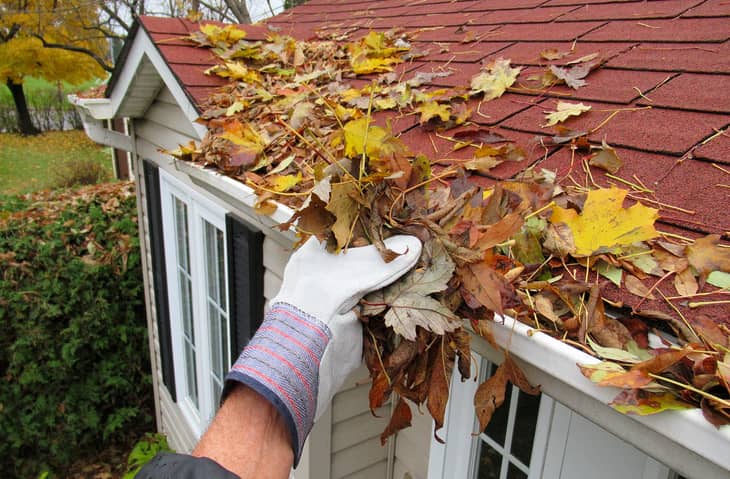
It is late September. The first leaves are on the lawn, the walnuts and ashes are already going, and the gutters are somewhere near the top of the list. So what should you actually do this week?
The answer most homeowners reach for — book one cleaning, get it over with — is why many pay twice. Gutter timing is not a calendar date. It is a signal, and the trees over your roof send it. Some are sending it now; others will not finish until December.
The short answer
If you have mature trees over the roofline, book now and plan on two passes. Clear the first wave in late September or early October — walnut, ash, birch and the early maples are already dropping — then take a final pass in November once the oaks finish. Homes with no oaks and light tree cover can manage a single cleaning in late October. Either way the hard deadline is the first sustained freeze, because water trapped in a blocked gutter freezes with the debris and cannot be safely removed until it thaws.
What to Do Right Now
Clear what is already in there. Your gutters are not empty going into autumn — they hold a summer of shingle grit, seed pods, moss and wind-blown dirt, and that layer is the base everything else mats onto. A channel with an inch of sludge cannot cope when three weeks of leaf litter lands on top, and autumn rain arrives before the leaves finish falling. Clearing it now is not premature; it is what makes the November visit straightforward instead of an excavation.
Book both passes, not just the first. November slots run out, because people book in the order they think of it rather than the order they need it. If you have oaks, November is the visit that matters — and it will be gone if you wait until the oaks look finished to call.
What you should not do is treat a late-September cleaning as the whole job — under mature canopy, the most expensive assumption in fall home maintenance.
Which Trees Are Dropping Right Now
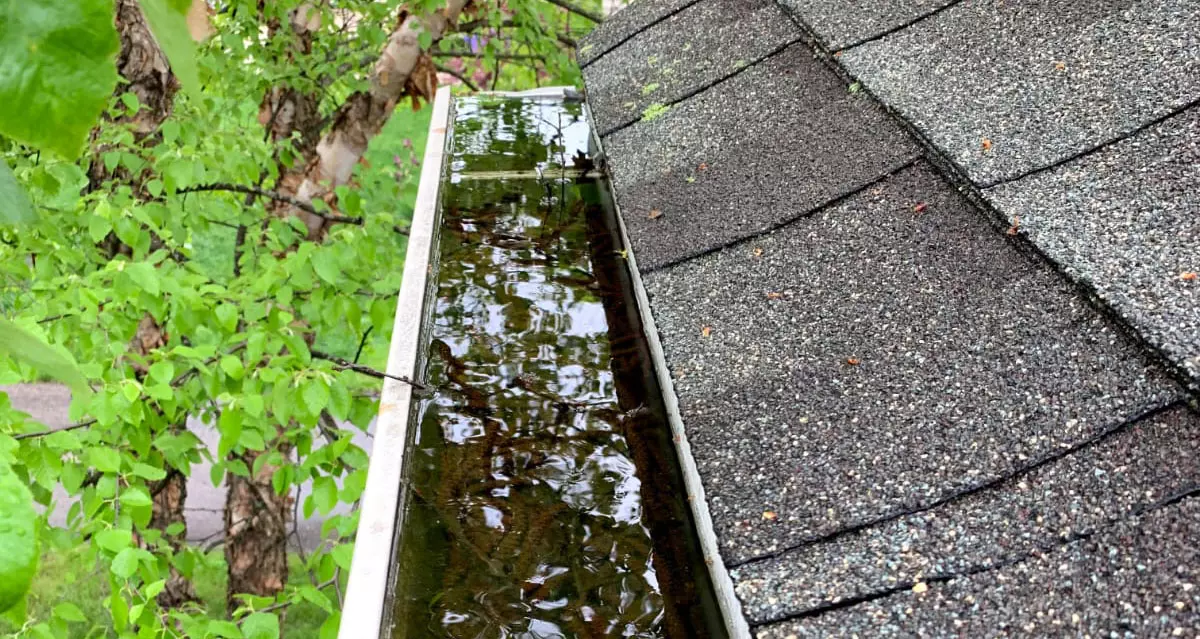
In late September and early October these species are actively filling your gutters: black walnut (earliest, plus husks that jam downspouts), ash (often done inside two weeks), birch (small leaves that slip through screen guards), silver and red maple (full to bare in ten days), and conifers, whose inner needles mat into a felt that sheds water sideways.
If that list covers everything over your roofline and there are no oaks, you need one cleaning and mid-to-late October is your window. If any oak, beech or callery pear is in the mix, your timing is different.
Leaf-Drop Timing by Tree
Trees do not drop together. On one street a walnut can be bare by early October while a pin oak sheds into December. Know what is over your roof and you can predict your window within two weeks. Windows below suit the northern and midwestern U.S.; shift later as you move south.
| Tree | Typical drop window | What it does in a gutter | Timing |
|---|---|---|---|
| Black walnut | Early Sept – early Oct | Leaflets plus husks that jam downspout elbows | Earliest |
| Ash | Mid Sept – mid Oct | Drops fast, often done inside two weeks | Early |
| Birch | Early – mid Oct | Small leaves that pass through screen guards | Early |
| Silver & red maple | Late Sept – late Oct | Large volume in a short burst; mats when wet | Early–mid |
| Sugar maple | Mid – late Oct | Heavy volume over two to three weeks | Mid |
| Honeylocust | Oct | Tiny leaflets slip through nearly every guard | Mid |
| Elm, linden, cottonwood | Oct | Steady mid-season volume | Mid |
| Ginkgo | Mid – late Oct | Drops almost the whole canopy in a few days | Mid |
| Sycamore | Late Oct – Nov | Big leathery leaves; classic downspout blockers | Late |
| Callery / Bradford pear | Nov – Dec | Holds leaves well past the first frosts | Late |
| Oak (red, white, pin) | Late Oct – Dec | Long, drawn-out shed in separate waves | Late |
| Beech | Nov – late winter | Holds dead leaves for months | Latest |
| Pine, spruce, hemlock | Sept – Nov | Needles felt together and resist decomposition | Overlaps all |
Why the Oak Second Pass Matters
One row causes most of the repeat visits in this industry. Oaks and beeches show marcescence — they form their leaf-shedding layer late or only partially, so dead brown leaves cling on through much of the winter. University of Illinois Extension covers the mechanism. Practically: an oak canopy is still feeding your gutters in December, weeks after the maples on the same lot went bare.
That is why a single October cleaning under oaks so reliably needs redoing. The awkward consequence is that you cannot wait for an oak to look finished — it will not, until spring. Book the final cleaning two to three weeks after your area's first hard frost and accept that some winter drop lands afterward. That residual is manageable. A full channel going into January is not.
Are Your Trees Actually Done? Three Free Checks
- The canopy check. Look up through each tree reaching over the roofline. See sky through most of the crown and it is essentially finished. Still holding colour and it is not.
- The lawn check. Clear one section, look again three days later after a dry, breezy stretch. A fresh layer means active drop. This is the most reliable of the three, because it measures what is still coming down.
- The gutter check. Photograph the gutter line at full phone zoom, or look down from an upstairs window. If debris is level with the lip, waiting is no longer free.
One Cleaning or Two?
Count only trees reaching over or within about thirty feet of the roofline.
- No mature trees near the roofline → one cleaning from mid-October on. Many such homes can go every other year, and we say so.
- Early and mid-season droppers only → one cleaning, late October to early November.
- Any oak, beech or callery pear overhead → two: an early pass now, a final pass in November.
- Conifers overhanging the roof → usually two; needle drop overlaps the leaf drop.
- Mixed mature canopy → two. No single date works for both ends of the range.
The Deadline: the First Hard Freeze
Once water in a blocked channel freezes, the gutter stops working, ice at the roof edge gives meltwater somewhere to pool and refreeze, and that water works backward under the shingles. That chain is covered in how gutter cleaning prevents ice dams — and ice dam removal costs several times a fall cleaning.
Plan around your average first freeze, not the first frost. For Chicago, the National Weather Service puts the normal first fall freeze at O'Hare on October 19 (1991–2020 normals), Rockford six days earlier. That is one cold night, not a hard stop, but the clock has started and the time runs out in early December.
Adjusting for Your Region
Peak leaf drop clusters in the three to four weeks around your average first freeze; late species trail by another three to six. Look yours up via your regional National Weather Service office.
- Freeze in early–mid October (Upper Midwest, northern New England, Rockies): main cleaning late October, late pass mid-to-late November.
- Freeze late Oct–early Nov (Chicago, lower Great Lakes, Ohio Valley): main cleaning early November, late pass into early December.
- Freeze mid-November or later (coastal Mid-Atlantic, upper South, PNW lowlands): main cleaning late November. The PNW usually needs two passes regardless.
- Little or no hard freeze (Gulf, Deep South, coastal California): go purely by the drop, often into January. Many live oaks and eucalyptus shed hardest in spring.
Booking: the Date You Are Offered Is Not the Date You Need

Here is something the trade does not advertise: we book fall gutter cleaning in the order people call, and so does almost everyone else. There is no clever system sorting your house by what grows over it.
That matters, because the schedule will not protect you from bad timing. Call in September, take the first slot offered, and you get a September cleaning — even if four mature oaks over your roof will still be dropping in December. The calendar does not know about your trees. You do.
So when you call, us or anyone else:
- Say what is over your roofline. Name the trees if you know them, describe them or send a photo if you do not.
- Ask for a date that fits those trees, not the soonest one on offer.
- If you need two visits, book both now. November fills up during October, and the November visit is the one that carries you through winter.
- Get the scope in writing — gutters cleared, downspouts flushed, debris removed.
We have cleaned gutters across Chicagoland since 2012 from three offices in Buffalo Grove, Libertyville and Lombard — see our service areas. Technicians are trained, insured and background-checked, quotes are free and written, and every job carries our 100% satisfaction guarantee. What we cannot do is guess what grows over your roof — tell us, and we will book the week that fits.
Do Gutter Guards Change This?
They change the interval, not the deadline. Guards stop whole leaves but not shingle granules, honeylocust leaflets or pine needles — and not debris matting on top, which sends water over the front edge. Same rule: check after the drop, before the freeze. See why gutter guards clog and what gutter guard cleaning involves.
Frequently Asked Questions
Should I clean my gutters in September?
It is a good time for a first pass, but not for your only one. A late-September cleaning clears the summer base — shingle grit, seed pods, moss — plus early droppers like walnut and ash, so your gutters work through autumn rain. The main leaf load has not fallen yet, so under mature trees you will still need a second visit in November.
When should I clean my gutters in the fall?
Once the trees over your roofline have finished dropping, not on a fixed date — roughly two to three weeks after the last tree overhead goes bare, which in the northern U.S. means late October to mid-November. The hard deadline is the first sustained freeze.
Should I clean gutters before or after the leaves fall?
Your main cleaning goes after; cleaning before the drop finishes only clears what has landed and refills within weeks. An early pass still has real value when gutters are carrying summer debris — treat it as the first of two visits, not as the fall cleaning.
How many times should gutters be cleaned in the fall?
Once, if every tree over the roof is an early or mid-season dropper. Twice, if you have oak, beech or callery pear overhead, or conifers overhanging. Mixed mature canopy almost always means two.
Is it too late to clean gutters in December?
Not automatically — what matters is whether the debris is frozen, not the date. In a mild, dry stretch a December cleaning is worth doing, because clearing the channel before January thaw-and-refreeze cycles keeps ice off the roof edge.
Can gutters be cleaned when they are frozen?
They should not be. Frozen debris has to be chipped out, which cracks seams and bends hangers — damage that outlasts the clog. The answer to a frozen, blocked gutter causing ice problems is steam-based ice dam removal.
Book the Right Week
It comes down to one question that has nothing to do with a calendar: what is growing over my roof, and has it finished? Answer that and the rest follows.
Right now, most homes with mature trees should get the first pass done and reserve November while November still exists. Tell us what is over your roofline — or send a photo — and we will tell you which week to book and what it costs. Call (224) 394-4494 or book gutter cleaning online in about a minute.
Enjoyed this article?
Get your gutters cleared in the right week, before the freeze.
Browse More Articles

